



Now we walk along the same street, in red pairs, and no man shouts obscenities at us, speaks to us, touches us. No one whistles.
There is more than one kind of freedom, said Aunt Lydia. Freedom to and freedom from. In the days of anarchy, it was freedom to. Now you are being given freedom from. Don't underrate it.
—Handmaid’s Tale, Margaret Atwood
Let’s get some specifics out of the way before we get to the Chief Justice’s recent reboot, a polemic titled “Putting the ‘Religion’ Speech in a Proper Perspective.” Me, I don’t care whether Mogoeng Mogoeng practices a hybrid form of Scientology and Bikram yoga that sees him spending his Sundays in a heat-treated shack doing downward dog according to a Tom Cruise diagrammatic. I don’t care if you, dear reader, do the same. I am not anti-Jesus, I’m not anti-religion, and I am well aware of how the Judeo-Christian tradition has influenced classic liberal documents like the South African Constitution. And while there are literally hundreds of examples of Mogoeng’s conservatism in his many years as a judge before he hit the CC, there are zero examples of religious zealotry in his recent judgments. Mogoeng Mogoeng may stand accused of being a Zuma lapdog, certainly, but one that has proved to be of the quieter, non-yippy variety.
Until now.
Rounding back to the main point of this preamble: it does not, should not, and cannot matter what religious shenanigans the Chief Justice practices in his spare time. Unless, of course, the Chief Justice suggests that it matters. Which, last week, he did.
In many respects, Constitutional Court justices exist within a tightly circumscribed intellectual fighting cage—their one job is to judge cases according to the laws of the land. In purely intellectual terms, it is always interesting to hear what these people think about faith, jurisprudence and the interaction of the twain. It is similarly interesting to dispense a resounding intellectual haymaker to their jaws should their positions prove idiotic.
I read “Law and Religion in Africa: The Quest for the Common Good in Pluralistic Societies” carefully last week. I read it again an hour ago. It is a bad speech that makes little sense, and what sense it does make suggests that Mogoeng’s version of Christianity should play a much greater role in “African societies”—and given that many “African societies” are governed by constitutions, these documents should ipso facto include more of Mogoeng’s church’s teachings in order to straighten the continent out. And while the body of the talk was a lengthy (and badly argued) “on the one hand/on the other hand” conversation between conservative religious/liberal legal positions, the speech called for more Pentecostal Christianity in the laying out of the law. There can be no other conclusions. That is what the Chief Justice said, even if he said it through a mouth full of marbles.
We now arrive at “Putting the ‘Religion’ Speech in a Proper Perspective”, delivered at a Wednesday afternoon press conference some hours ago. The speech was meant to clear up the confusion, although I’m not sure who was confused. Mogoeng sought to remind his audience, some of whom had made “interesting comments” that were “perhaps somewhat personal and animated”, that his controversial speech was designed for a “historic” conference on law and religion in Africa. The point of the conference was to bridge these two concepts, which is inarguably fascinating.
Time, then, to lay out a personal and poignant explanation of how the Chief Justice subtly merges his heart and his head in the context of his Constitutional Court commitments, and to clear up some of the fuzzier ideas in his initial speech?
No such luck.
This is partly because the Chief Justice is obsessed with sex. More specifically, he is obsessed with how other people have sex. He believes that adultery is a contributing factor to the breakdown of “African society”, one that results in “deaths borne out of jealousy”. Fornication damages young children, and damaged young children in turn damage society. And while the Constitution protects our right to screw around as much as our dwindling good looks allow, such behaviour leads to “health risks”. What’s more, “the rights of others who unknowingly participate in such a relationship deserve some attention”.
In this, principles “from all religions, could be of some help in this regard. Those principles could be infused for example into a national moral code that could be taught at home and school from a tender age all the way up to adulthood.”
A “national moral code”? So far, so Handmaid’s Tale. You know, Margaret Atwood’s dystopian tale in which a near future America is governed by a “national moral code” infused with evangelical teachings, in which women are forced to become breeding machines for an extractive gerontocracy?
Spoiler alert: it’s not a comedy.
Mogoeng then reminded us that religious intolerance is illegal in this country. He reminded us that religious principles and the evincing thereof constitute freedom of speech, and that no one should be censured for their views. “We are equal in our diversity” and holding an opinion, religiously-tinged or otherwise, is a right “to be enjoyed by all.”
But child rape, HIV, Aids, etc., plague Africa like, well, the plague, and religion can help clear this stuff up, sort of like a super-powerful ARV. There are sound principles that could “cut across the religious divide” and “blend well with the existing legal architecture and philosophy, that could further improve our legal systems.” Religion, the law and morals cannot be separated, he insisted. They can and should be integrated, and this can and should be done because South Africa has long been a first mover in innovating solutions to the redressing of past evils. “Religion, properly practiced, does not militate against the common good of all.”
Then he said, “May God bless you all.”
In short, let’s allow religion and the law to mate like one of Mogoeng’s lusty fornicators, and all be governed by their offspring.
Are we clear now? I hope we are.
Interesting fact: not once, in thousands of words of his garbled fulminations, did Mogoeng Mogoeng the Man of Faith, mention Africa’s real evils: rampant inequality and poverty. Not once. Why might that be? Perhaps it's because he believes that when our morality is properly policed, when our bedrooms are scoured of sin, our societies will strengthen to the point that, now shorn of Aids and other sexually transmitted diseases, we’ll all have the strength and fortitude to become stock brokers and bankers?
Why does the Chief Justice not suggest that sticking to some basic moral principles—don’t steal from your constituents; don’t lie to your constituents; do more objective good than objective evil—might be present a less radical first step? Why does he not suggest that governance is not a key issue in “African societies”? Maybe because that wouldn’t be of much interest to the attendees at a religion and law conference? Maybe because it would piss off his sponsors in government? Maybe because he believes that hyper-conservative religious morality trumps basic political morality?
Who can say?
I’ll say this, though: Mogoeng Mogoeng has now had two kicks at the can, and he sounded like just the same the second time. He is calling for a form of moral control, a handbrake on our constitutionally enshrined rights to behave like depraved assholes, instead of calling to task those that have let us down, those that have abused us, those that have behaved contrary to the teachings of his Lord. Mogoeng Mogoeng doesn’t want our leaders to obey the law, he wants us to behave according to the morals of some narrowly defined religious mish-mash. And who would do the defining?
Take a flying guess.
Anyway, I hope this has put all the confusion to pasture. Mogoeng Mogoeng has now been clear, which is to say he has increased the obtuseness. But we know all to well the evil that a “national moral code” governed by “religious principles” can bring.
As the narrator of Handmaid’s Tale puts it, “Maybe none of this is about control. Maybe it isn't really about who can own whom, who can do what to whom and get away with it, even as far as death. Maybe it isn't about who can sit and who has to kneel or stand or lie down, legs spread open. Maybe it's about who can do what to whom and be forgiven for it. Never tell me it amounts to the same thing.” DM
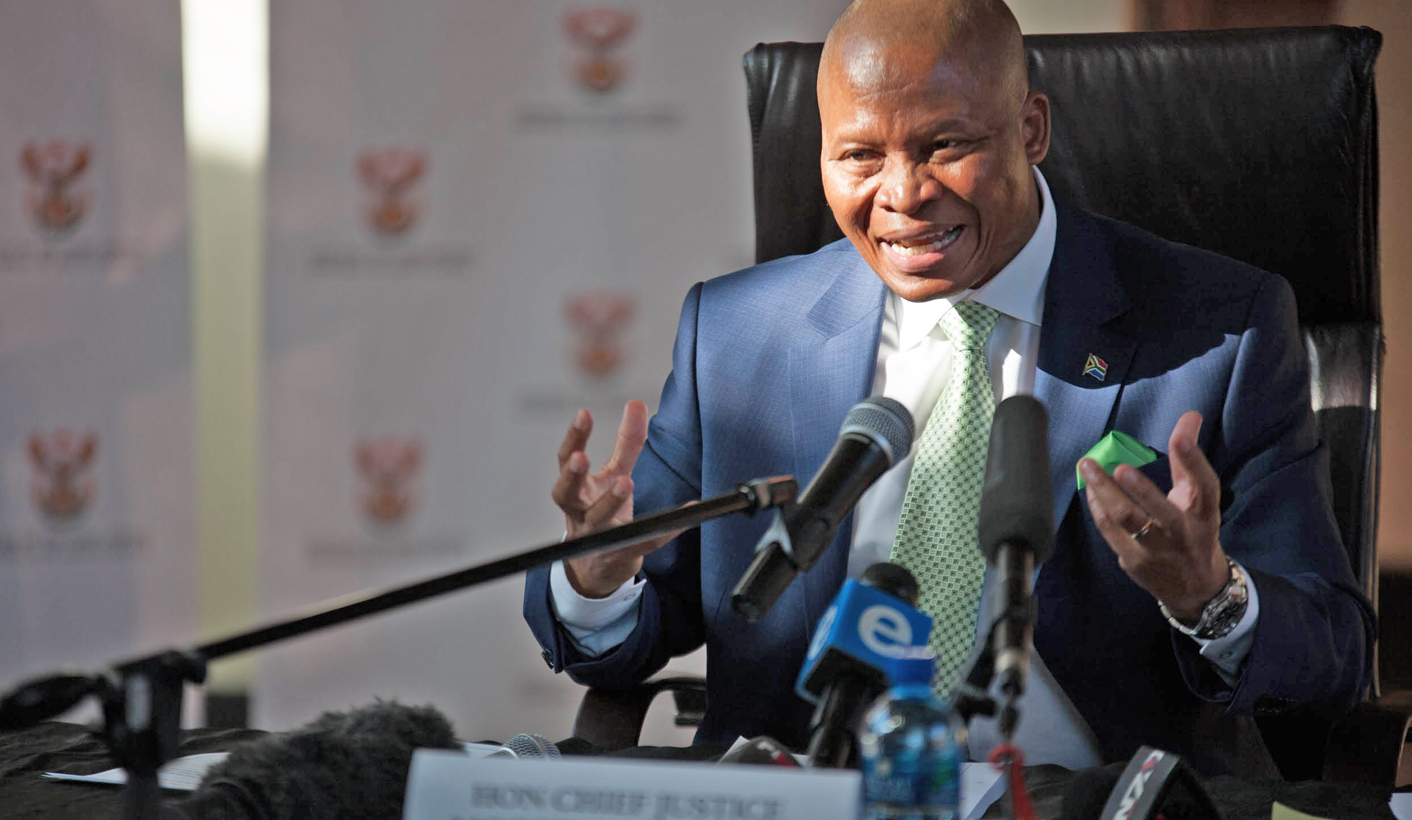
Photo: Chef Justice Mogoeng Mogoeng (Greg Nicolson).
Comments
Scroll down to load comments...